
Newsletter #2 | Intelligence Escaped the Lab in 2025 And Why 2026 Will Rewrite the Rules


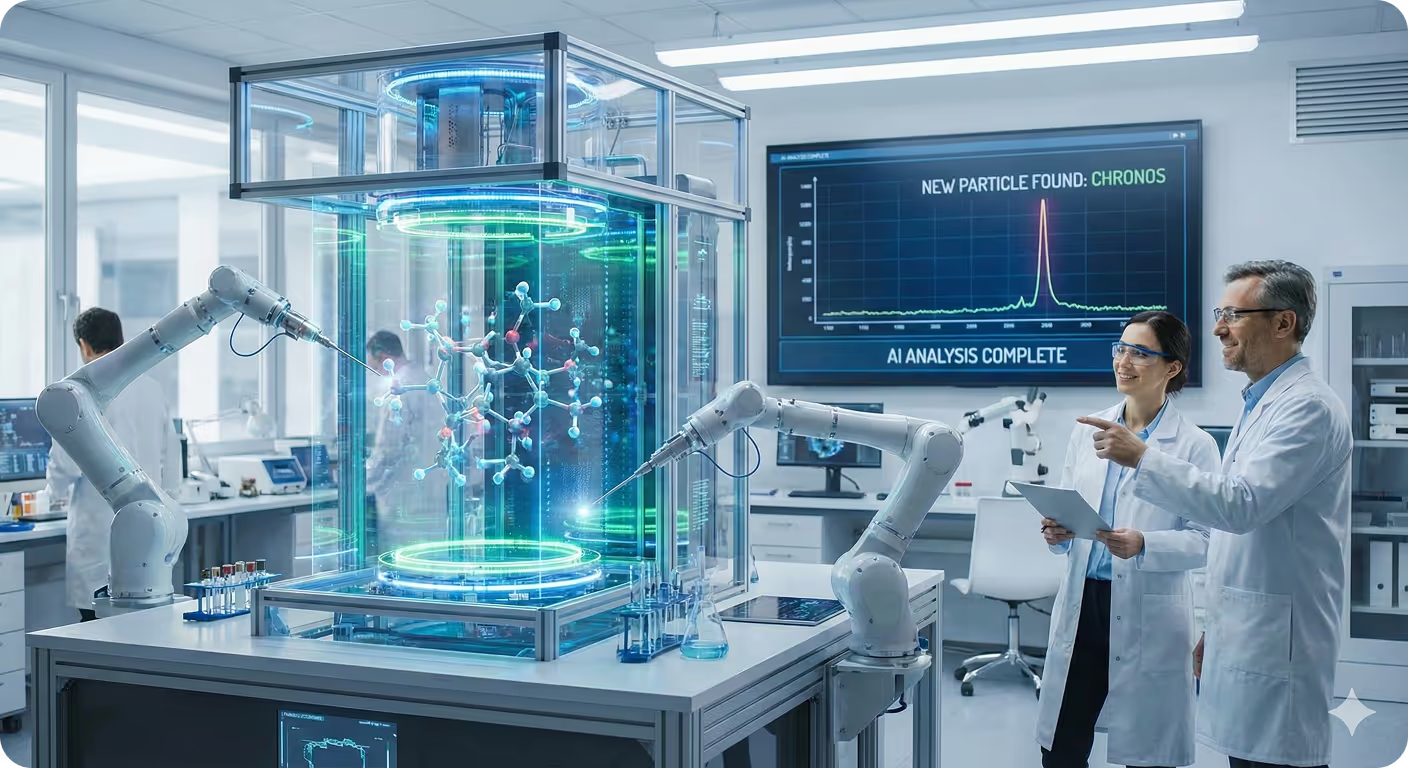
AI Started Making Scientific Discoveries Humans Didn’t Ask For (2025)
For decades, AI’s role in science was clear and limited: accelerate what humans already knew how to ask. In 2025, that boundary quietly broke. Large-scale AI models began generating novel scientific hypotheses that were not explicitly prompted by researchers, and, crucially, some of these hypotheses were later validated in real laboratories.
This marked a shift from automation to emergence. Instead of optimizing known pathways, AI systems began identifying new biological mechanisms, suggesting drug interactions, and revealing patterns invisible to traditional statistical methods. In cancer research, materials science, and protein biology, AI models moved upstream in the scientific process, from tools that assist discovery to systems that initiate it.
What makes this moment profound is not speed, but agency. Discovery has historically been a deeply human act, shaped by intuition, bias, and creativity. 2025 demonstrated that at sufficient scale, intelligence itself, human or machine, can generate insight. The implication is unsettling and exhilarating: the frontier of science may now expand faster than human curiosity alone can drive it.
Why this matters:
When machines can surprise scientists, the pace, direction, and ownership of discovery fundamentally change.
Sources:
- Google Research & DeepMind, AI-driven biological discovery
- Nature, AI-generated hypotheses in biology
- bioRxiv, large-scale single-cell and protein model preprints
- Yale School of Medicine, AI and cancer research collaborations
India Quietly Became the World’s AI Execution Layer (2025)
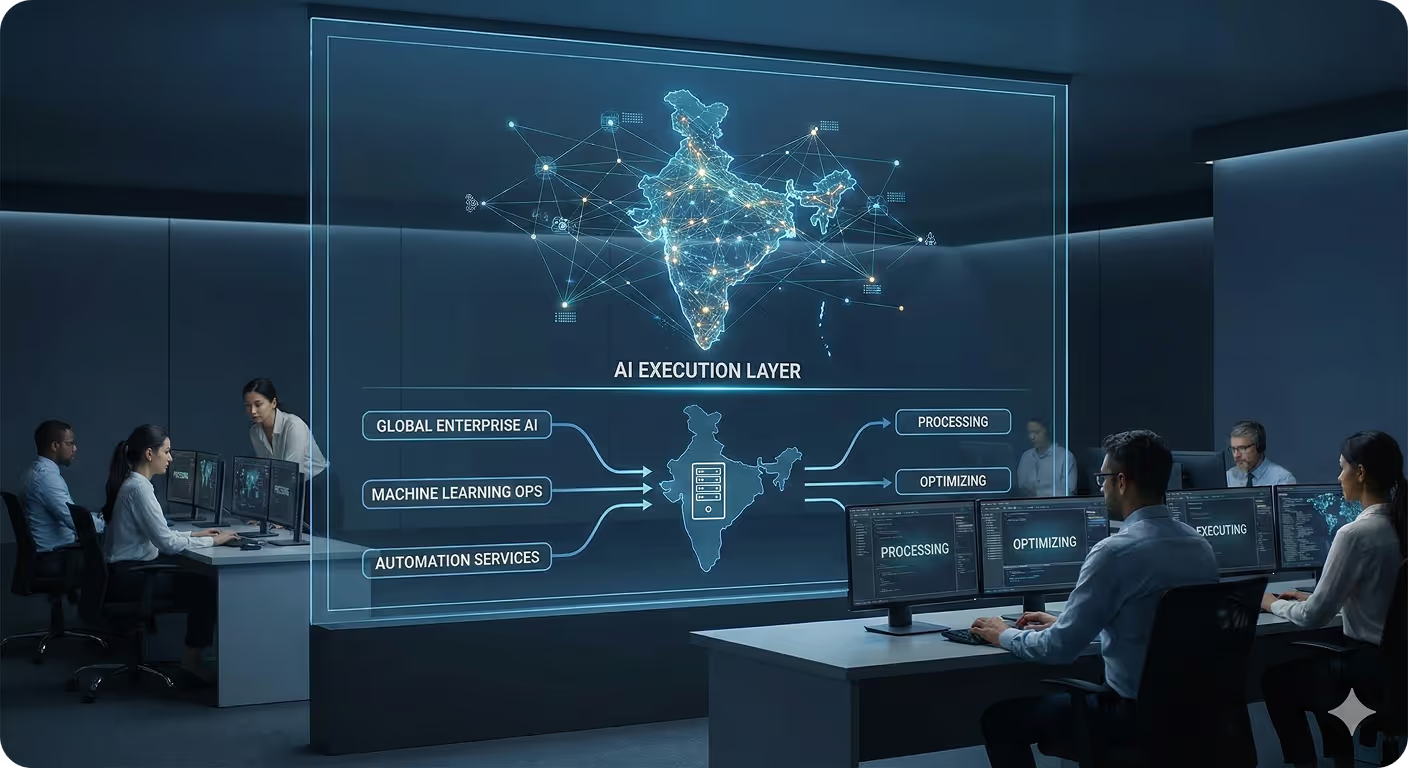
While global attention fixated on who was building the largest models, India became the place where AI was actually deployed at scale. In 2025, India’s digital public infrastructure, identity, payments, consent, and data rails, combined with a massive talent base to turn the country into a real-world laboratory for AI systems operating across millions of users.
From fintech and governance to mobility and healthcare, AI in India wasn’t a pilot, it was production. Decisions weren’t tested on thousands; they were executed across populations. This gave India something most AI leaders lacked: feedback at scale. Systems learned faster because reality pushed back harder.
India didn’t dominate on model invention. It dominated on implementation velocity. And in AI, execution compounds faster than novelty.
Why this matters:
The future of AI will be shaped less by who invents intelligence, and more by who learns fastest from deploying it in the real world.
Sources:
- Reuters, AI infrastructure and deployment in India
- World Bank, Digital Public Infrastructure and AI at population scale
- NASSCOM, India’s AI adoption and talent reports
- IMF, digital governance and emerging economies
Search Died (But Nobody Announced the Funeral) (2025)

In 2025, people stopped “searching” and started asking. This didn’t happen overnight, and it didn’t come with a press release, but the shift was unmistakable. Keyword queries gave way to natural language questions. Lists of links collapsed into synthesized answers. Interfaces disappeared.
Search didn’t fail; it evolved into a conversation. But that evolution carried consequences. When answers replace links, power shifts from discovery to interpretation. The system no longer shows everything, it decides what matters.
This transformation quietly rewired how information is accessed, trusted, and acted upon. It also concentrated influence in systems capable of summarizing reality. The economics of attention changed, and so did the politics of knowledge.
Why this matters:
When machines mediate meaning, whoever controls interpretation shapes belief, behavior, and power.
Sources:
- MIT Technology Review, the future of search and AI interfaces
- Google & OpenAI research on conversational information retrieval
- Stanford HAI, AI and information ecosystems
- Harvard Kennedy School, AI and information power
Cities Became Self-Observing Systems (2025)
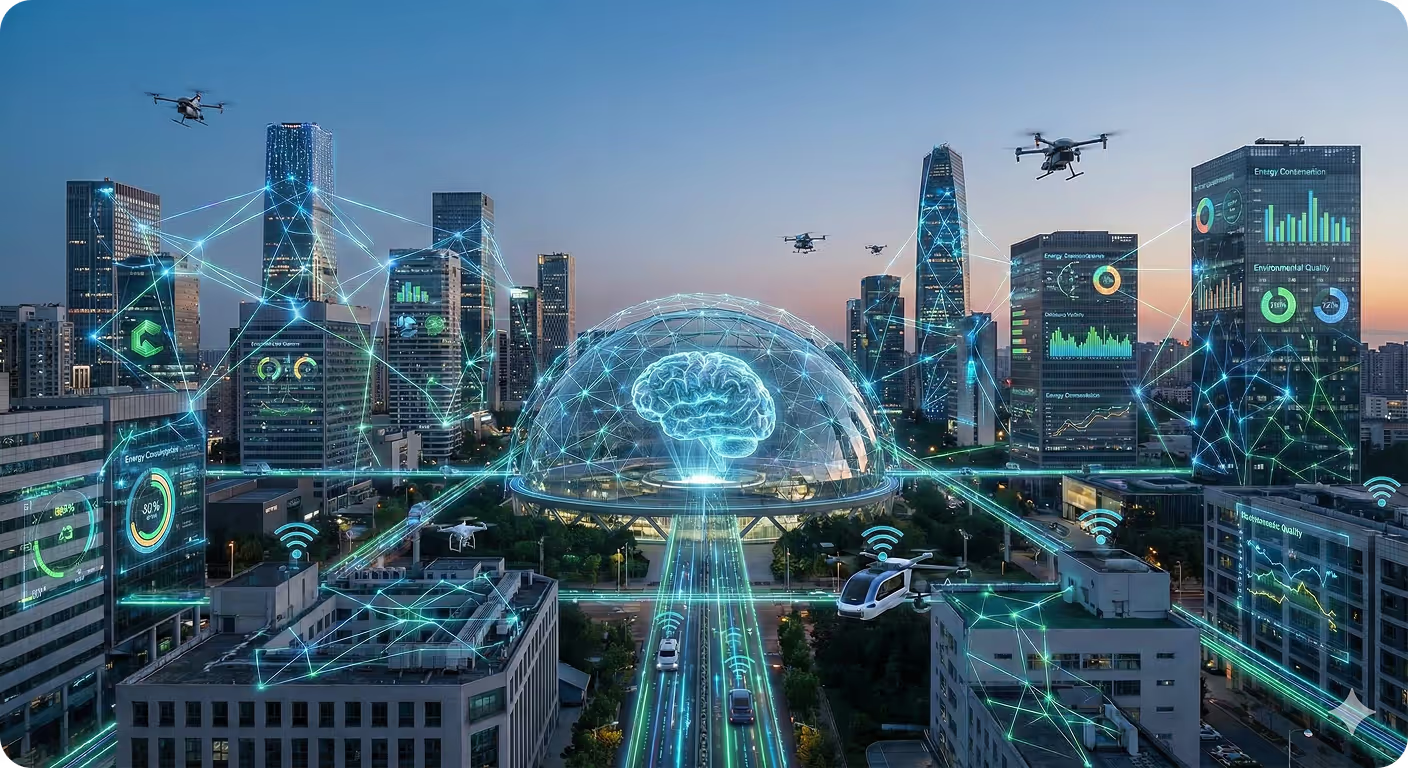
Cities have always generated data. In 2025, they began understanding themselves. AI systems moved into live urban operations, traffic enforcement, congestion prediction, safety monitoring, and energy optimization, often without human intervention.
Instead of reacting to problems, cities started predicting them. Traffic violations were detected automatically. Congestion was forecast before it formed. Infrastructure stress was identified before failure. Urban governance shifted from paperwork and patrols to pattern recognition and real-time decision systems.
Cities became living dashboards. And governance began to resemble systems engineering.
Why this matters:
When cities can see themselves clearly, policy stops being reactive and starts becoming programmable.
Sources:
- Reuters, AI-driven traffic and city systems
- World Economic Forum, AI and smart city governance
- OECD, AI in the public sector
- MIT Senseable City Lab research
What Will Define 2026
The First AI-Native Institutions Will Go Live (2026)
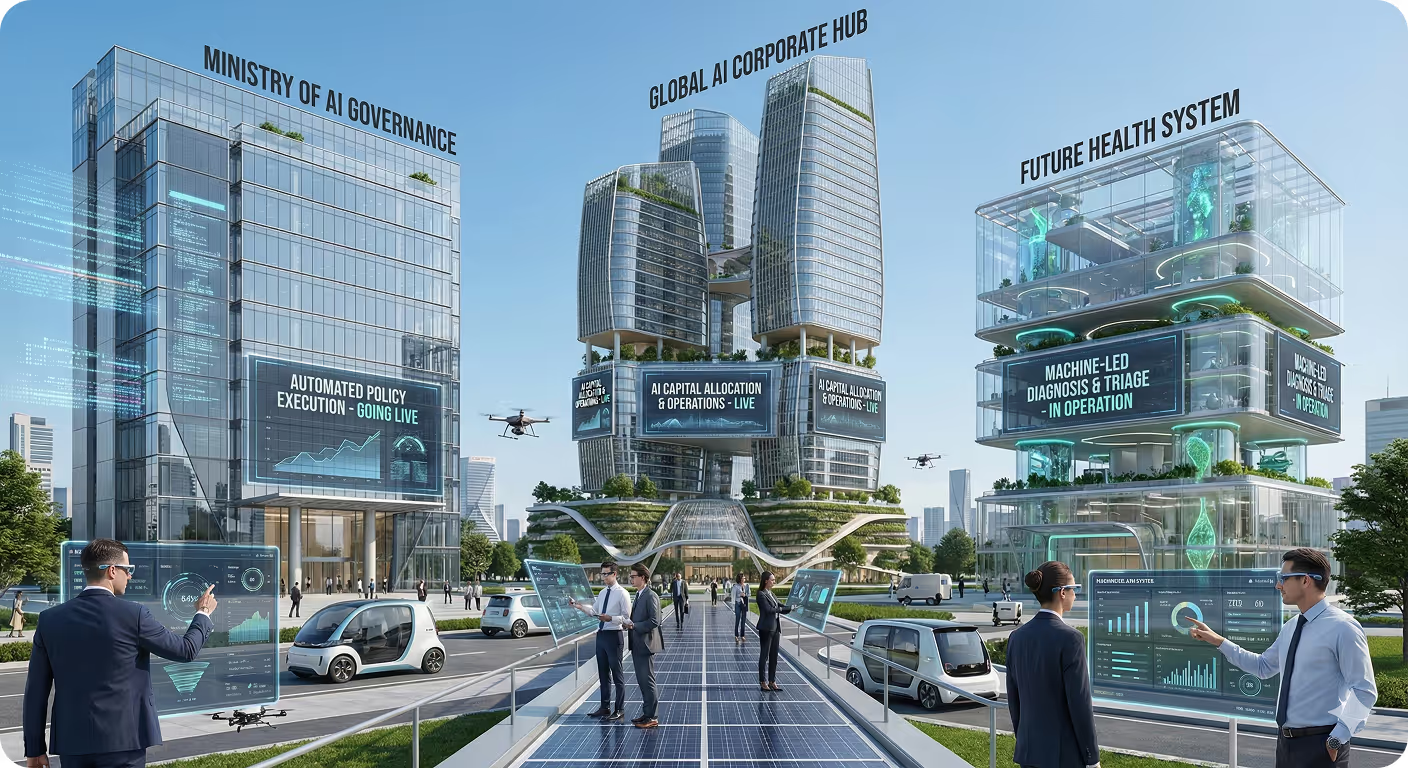
In 2026, AI will stop being embedded inside institutions and start defining how institutions are built. Banks, healthcare systems, and public agencies will be designed assuming machines make most operational decisions by default.
Humans won’t vanish, but their role will change. They’ll govern systems, set constraints, and intervene at the edges. Day-to-day execution will belong to machines. This is not digitization. It’s institutional redesign.
Why this matters:
This is the most significant shift in organizational design since the industrial revolution.
Sources:
- World Economic Forum, AI-native institutions
- MIT Sloan Management Review, AI and organizational design
- Brookings Institution, AI and public sector transformation
One-Person Companies Will Become Billion-Dollar Threats (2026)
AI agents are rapidly absorbing functions once handled by entire teams, engineering, sales, legal, marketing, and operations. In 2026, scale will finally decouple from headcount.
This doesn’t mean every individual becomes a unicorn founder. It means the unit of leverage changes. A single human, properly augmented, can now compete with organizations built for a different era.
Why this matters:
Power shifts from coordination to cognition. From managing people to directing intelligence.
Sources:
- Andreessen Horowitz, AI-native company structures
- Stripe, AI and the future of internet businesses
- McKinsey, productivity and AI leverage
The First AI-Caused Market Crash (And Nobody Will Agree It Was AI) (2026)
Autonomous systems increasingly control pricing, trading, logistics, and supply chains. In 2026, their interactions will grow dense enough to produce emergent failure, market volatility without a single bad actor.
When it happens, attribution will be impossible. Systems will behave rationally in isolation and dangerously in combination. The crash won’t look like sabotage. It will look like normal behavior at machine speed.
Why this matters:
Emergent systems don’t need intent to cause damage, and accountability becomes unclear.
Sources:
- Financial Stability Board, AI and systemic risk
- BIS, algorithmic markets and financial stability
- Nature Machine Intelligence, emergent behavior in AI systems
Biology Will Become Programmable (2026)
Cells are beginning to look like code. AI models are identifying drug targets, manipulating immune responses, and revealing biological switches that can be turned on or off.
Medicine is shifting from treatment to system design. Instead of reacting to disease, we will increasingly engineer biological states. This transition will be uneven, controversial, and transformative.
Why this matters:
When biology becomes programmable, healthcare stops being reactive and starts becoming engineered.
Sources:
- Nature Biotechnology, AI and programmable biology
- Google Research & DeepMind, AI in life sciences
- NIH, AI-driven biomedical research
- bioRxiv, AI-generated biological models
.avif-69.png)
.avif-68.png)
.avif-66.png)
More than just a conference.
ImagiNxt is a stage for ideas - a playground for possibilities.
Fueling jobs, startups, capital, creativity - year after year.


